
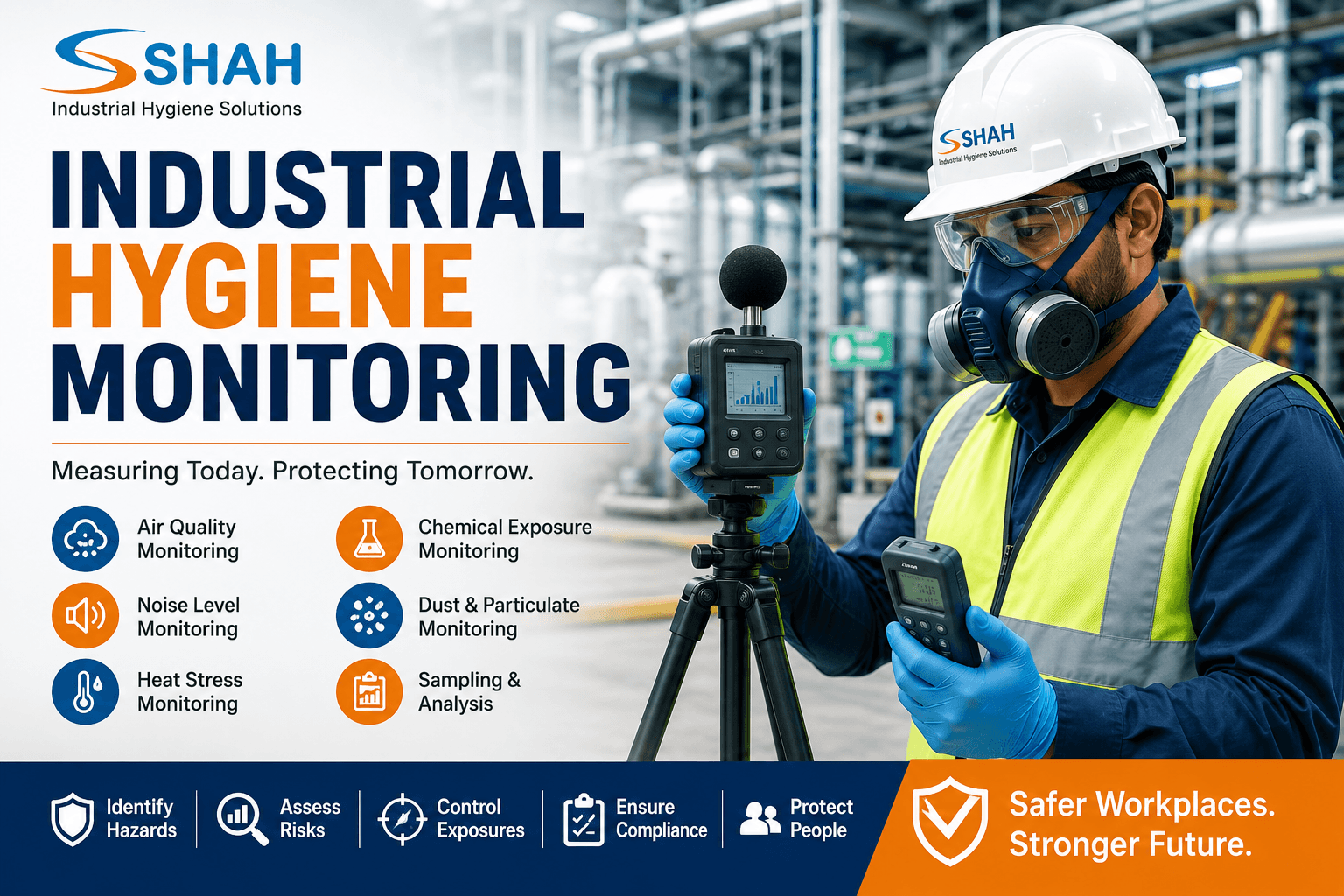
A safe workplace is not only about preventing accidents.
Employees may also face invisible risks such as chemical vapours, dust,
excessive noise, heat, poor air quality and other occupational hazards. Industrial hygiene
monitoring helps organisations identify these risks, measure employee
exposure and take timely corrective actions.
Industrial hygiene monitoring is a systematic process of
recognising, evaluating and controlling workplace health hazards. It provides
businesses with reliable information about workplace conditions and helps them
develop practical measures to protect employees.
Why Is
Industrial Hygiene Monitoring Important?
Regular monitoring allows organisations to understand
whether employees are being exposed to potentially harmful conditions during
their routine work. It can support better workplace decisions while
strengthening occupational health and safety practices.
Key benefits include:
- · Identifying workplace hazards before they become serious problems
- · Measuring exposure to chemicals, dust, noise, heat and other physical agents
- · Supporting effective engineering and administrative controls
- · Improving employee health and workplace wellbeing
- · Supporting compliance with applicable safety requirements
- · Providing documented data for safety programmes and risk management
- · Helping organisations reduce the possibility of occupational illnesses
What Does Industrial Hygiene Monitoring Cover?
A professional monitoring programme can cover different
workplace conditions depending on the industry, processes and identified risks.
Common assessments include:
- · Air and chemical exposure monitoring
- · Occupational noise exposure assessment
- · Heat stress assessment
- · Indoor air quality assessment
- · Illumination surveys
- · Vibration studies
- · Area sound level mapping
- · Ventilation and Local Exhaust Ventilation (LEV) evaluation
- · Personal Protective Equipment (PPE) assessment
From
Monitoring to Practical Workplace Improvements
The real value of industrial hygiene
monitoring lies not simply in collecting measurements, but in using the
findings to improve workplace conditions. Depending on the results,
organisations may consider better ventilation, process modification,
substitution of hazardous materials, administrative controls or appropriate
PPE.
Professional interpretation is especially important for
industries such as pharmaceuticals, chemicals, manufacturing, oil and gas,
construction, healthcare, mines, cement and metal production, where employees
may encounter multiple occupational hazards.
Choose
Experienced Industrial Hygiene Support
SHAH Industrial
Hygiene Solutions provides industrial hygiene services covering
qualitative and quantitative exposure assessment, heat stress, occupational
noise, indoor air quality, ventilation, PPE and other workplace assessments.
The organisation serves several industrial sectors and focuses on practical,
cost-effective workplace health solutions.
A well-planned industrial hygiene
monitoring programme can help businesses move from reactive safety
management to proactive risk prevention. By identifying workplace exposures
early and acting on reliable data, organisations can create healthier
workplaces while supporting productivity, employee wellbeing and long-term
operational sustainability.